Teachers should teach, not be police
Visit NBCNews.com for breaking news, world news, and news about the economy
The Sandy Hook massacre inside an elementary school has shocked us all. While we want everyone to be safe, we expect our youngest to be so inside their own school.
My children attend Clayton School District, one of the wealthier districts in St. Louis County. Like many local districts, it already has police officers at the high school and middle school. On Monday when I went to pick up my youngest, I saw a different police officer at the elementary school. I was a bit taken aback but assumed he was there to help parents feel more secure in the first few days after the Connecticut shooting. I am hopeful that the district does not spend money to keep police officers or even armed security at the elementary schools long-term as the expense would not be justified.
Other school districts such as Kirkwood and Florissant are considering police officers at elementary schools in their school safety reviews. I believe, however, that time and calm parents will help them spend limited resources wisely.
I do agree that schools should review safety procedures as they have after each school shooting and periodically otherwise. Safety experts learn from each experience. For example, whoever turned on the intercom at Sandy Hook, whether intentionally or not, alerted the teachers to the severity of the problem. These types of details are important to safety plans.
St. Louis County Police Chief Tim Fitch said that each officer costs a district about $50,000 for a nine month contract. (Really a 10-month contract) In order to afford that, the district would need to lay off a teacher at each elementary school. That is not a trade-off I am willing to make.
As an alternative to paying for police officers at the schools, some politicians such as Texas governor, Rick Perry, have advocated arming teachers as a way to make schools safer. On Sunday, Chief Fitch brought the gun control debate squarely to the St. Louis school districts.
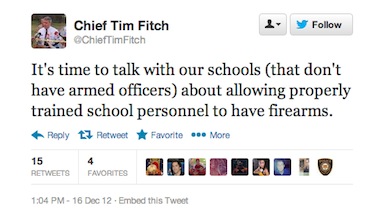
The St. Louis Post-Dispatch followed up with a front-page story discussing Fitch's suggestion and other security possibilities. The local districts did not react with enthusiasm.
Fred Crawford, chief of security for the Parkway School District, said he would favor more police in schools over gun training for school officers.
The districts are right to hesitate. Teachers with guns in the classroom, even in a locked drawer, would bring a whole new set of problems to schools. That gun is more likely to be found and used against the teacher or other students, the teacher is not going to be as experienced as an active police officer, that gun is unlikely to be useful against a prepared killer like Adam Lanza with a bulletproof vest on, the teacher would be spending time helping students to safety, police might mistake teacher for intruder etc. I would not send my kids to school with a teacher carrying a gun or with a gun in a locked drawer in the classroom. If the gun is locked up in the office, I would still feel uncomfortable. Who would have access? Have the parents been notified who has access? Their training? The date and continuation of their training?
In addition, districts hire teachers to teach, not to act as security.
"I'm a former teacher and my daughter teaches currently. I want our teachers to be trained so that we can address the problems of literacy, so that we can improve our education system. Let the public safety people handle these other issues." --Rep. John Larson (D) Conn. on NOW with Alex Dec. 17, 2012
Districts should re-evaluate their safety plans and assess whether to add more security, depending on the local needs, not as an emotional reaction to a horrific situation. They should not, however, ask teachers to become that security force.
Canyon between high school and college expectations

(Photo by OliBac)
UMSL, Mizzou and the other UM-System campuses require students to have a 24 composite on the ACT or equivalent SAT scores to be accepted as freshmen. (They can be accepted with lower scores with high grades and class rank. See rubric.)
Unfortunately, our high schools are not graduating students at that level. The average ACT composite score in Missouri is 21.6 It's much lower at some of our metro school districts.
Clayton School District provides a good picture since they have all (or almost all at 92.48%) seniors take the ACT. In 2011, they had a composite score of 25.8, well above the state average and above the state university cut-off. However, the UM campus cut-off of 24 is a minimum, not a mean, so even many Clayton students wouldn't test high enough to be accepted.
Ferguson-Florissant had 68.75% of its seniors take the ACT in 2011 with a mean composite score of only 18.4. In order to be accepted to Mizzou or UMSL with that ACT score, a student also has to be in the top 14% of their class and have a 3.5 gpa in their core classes (no padding!).
Riverview Gardens seniors don't have much of a chance. In 2011, 58.74% of seniors took the ACT with a dismal composite score of 16.1. If their ACT score is below a 17, no matter what their class rank or grades in their core classes, they will not be admitted to Mizzou or UMSL. Being accepted to a 4-year state university will be challenging for most students from Riverview Gardens, nevermind the costs. There is a reason this district is currently unaccredited.
Every child should graduate from high school with the option of going to college, whether they choose to or not. The difference in expectations between high school graduation and college entrance is a canyon rather than a ravine for too many of our kids.
Spanking still legal?
When I was in elementary school, I remember one kid who had to go to the principal. The rumor was that he was spanked. I'm not sure how we all knew, but we did. Since I'm ancient (at least my middle school daughter tells me I am), I assumed that would never, ever happen in public schools today.
And then I read the article in Huffington Post about a high school "high-achieving" (shouldn't matter) girl who had bruises and blisters after being spanked by a male administrator. Since spanking is apparently common in Texas, the article focuses on the high school's "oops" moment of having a male administer the corporal punishment instead of a female.
My first reaction was that this was a sensationalized Huff Post story, but after doing a bit of research I found out that corporal punishment is still legal and practiced, not just in Texas but in Missouri too (Mo Revised Statutes 160.261. 1.) In fact, Missouri kids are spanked in public schools on a regular basis. Who knew? In 2006 districts in Missouri reported 5,159 incidents of corporal punishment. Ed.Gov
Schools would only have to require parental notification if that is part of the district policy. Wow. Oh. Wow. This, of course, would never fly in your wealthier, high-parent-involvement districts in St. Louis County.
On the Ed.gov site I looked up several geographically diverse county districts (Webster, Pattonville, Mehlville, Hazelwood, Normandy), none of which showed any instances of corporal punishment. I was surprised, however, to see that the St. Louis City schools did use corporal punishment. (70 instances per Ed.gov site) I was right to be surprised as spanking is against SLPS board policy as stated in the current faculty handbook.
Corporal punishment of any kind is not permitted in the St. Louis Public Schools. Any employee who uses physical force or the threat of physical force as a means of student discipline or punishment shall be subject to disciplinary action, including discharge. (SLPS Faculty Handbook 2012-2013) adopted 1991 revised 1999
I will be interested to see if that number is 0 when the 2011-12 numbers from the Civil Rights Data Collection on the Ed.gov site are released.
The Texas school district solved its dilemma by ruling that administrators could use corporal punishment on members of the same sex, which goes in the wrong direction.
Which Missouri legislators will step up and protect our children?
"Slap Yo Mama" offensive, not funny
My kids may think it's funny, but I find the Green Light Auto Credit ad offensive. "It's so easy, it makes you wanna slap yo mama." It runs on Z107 all the time (among others I'm sure, but that's the one I hear it on), which skews young and female.
The 2002 movie Friday After Next brought the phrase to the mainstream (see YouTube above). Currently, a line of Louisiana seasoning, a food truck in California and BBQ house in Mississippi all take their name from this not-so-funny saying.
Joking to teens about domestic violence in order to sell car insurance should not be acceptable. Surely companies can show their creativity and make better ads without either harming or pissing off their potential clients.
Districts Need Higher Math Expectations for All
Cross-posted to Clayton Richmond Heights Patch
School districts throughout Missouri are reevaluating their math programs because the state is planning on adopting the new Common Core standards. While some people may balk at the idea of nationalized standards, politicians need to put their petty power disputes aside and look at what is best for kids. Massachusetts said it would not join the coalition unless the standards were at least as rigorous as its own, driving the standards up rather than the more typical downward spiral we tend to expect. While the Missouri MAP tests are challenging, the standards were poorly written. Adopting the Common Core standards is a positive step.
Clayton School District's math curriculum committee has made some substantial recommendations in its cyclical review of the math program. Other districts will be looking at their math programs whether they are up for review or not because of the upcoming changes in standards.
Clayton recommended changes:
•eliminating the integrated math sequence at the high school
•requiring the majority of 8th graders to take a full algebra course in 8th grade instead of the “algebra light” course currently taught
•recommending new textbooks for the high school and middle school (elementary will be reviewed this coming year)
•beefing up content mastery and fluency at the elementary
•requiring Algebra I level knowledge for all elementary teachers, Algebra II level knowledge for middle school math teachers
While the board seemed pleased with the amount of work put into the 621-page document, the members were not completely satisfied. They wanted more.
“Will this document guide us to ensure our teachers and curriculum teach a variety of ways so all of our children can excel?" she [Susan Bradley-Buse] asked the committee. “I don’t see that in here.” (Travis Pringle, “Math Curriculum Update Draws Questions on Textbooks, Teaching Styles”Clayton-RH Patch 29 April 2011)
I want to see math educators broaden their view. Instead of focusing on test scores and teacher recommendations to select a few students into the honors sequence, they need to emphasize looking at practices that can help as many students as possible excel at a high level.
Districts often provide support structures for struggling and exceptional students, but what about making those available for a wider base? For example, Clayton currently offers extra support courses for students in regular math classes so that they can be successful. This can help many students avoid taking less-intensive courses but gives them the extra help needed. I think this is a wonderful concept that should be more broadly applied. Possibilities could include a summer class to help middle school students move from regular math to honors, tutoring sessions taught by college and high school students, support groups for math anxiety, etc.
Finland consistently ranks at or near the top on the international test PISA. All students take the same course together with struggling student provided extra help.
A tactic used in virtually every lesson is the provision of an additional teacher who helps those who struggle in a particular subject. But the pupils are all kept in the same classroom, regardless of their ability in that particular subject. (Tom Bridge, “Why do Finland’s Schools Get the Best Results?” BBC 7 Apr 2010)
U.S. students are not the same as those in Finland, but teachers here can learn from their strategies for helping all students.
Moving algebra to the 8th grade for the majority of students is a good first step, which I would like to see replicated across the metropolitan area, but I think we need to go further. Students should be encouraged, not discouraged to challenge themselves even if it takes some extra work.
I’m not advocating eliminating honors courses but emphasizing to students that practice and hard work is more important than innate ability in achieving at a high level in math. If districts start ability grouping at a young age, they have a responsibility to counter that unspoken message by providing creative and productive extra support all students could use to excel in math.