Teacher quality matters
If improving teacher quality is the number one (hat tip Lee Rakes) way to improve education, what are some ways districts and states can do that? I wish I had the magic answer, but I do think we have some examples for the right direction.
1. Support beginning teachers better. Mentor teachers are a start but not enough. One year my dad worked in a quasi-administrative position as a support for first year teachers in his district. The situation was ideal for those teachers because he was in a solely supportive role, not evaluative. He also observed experienced teachers who excelled in challenging situations the first year teachers were having so that he could share ideas. Since his position was districtwide, he facilitated conversations between teachers in different schools. I would take this idea and expand it to include the first three years of teaching. The position could be full or part-time for a master teacher, depending on the size of the district.
2. Provide more time for working collaboratively. Teaching in isolation can lead to burn-out and lack of growth. Working as teams, either as grade levels in elementary school or middle school or as content areas in high school, can help the more inexperienced teachers learn, invigorate the veterans and improve everyone. Time for cross-team work such as interschool or across the grades needs to increase also. Parents at my kids’ elementary school were surprised to learn that teachers only met with their counterparts at the other elementary schools twice a year and on specific topics. A subject such as math may not be addressed formally at all in a year. I, personally, thought the district was generous in giving them two times to meet—an obvious difference in perspective from an educational point of view than a business point of view.
3. Require meaningful professional development. I’ve been to workshops, conferences, classes and meetings that have made me a better teacher and ones that have been a waste of time. Targeted professional development though is necessary for any profession, including teaching. One of the reasons I chose my children’s pediatric group was that the doctors attended weekly lectures at Children’s Hospital. Doctors also must keep up by reading journals and attending lectures and conferences. I expect educators to do the same.
4. Change student teaching structure. Student teaching should be a one-year, paid internship for those who have already completed their degree. Schools have a commitment to student teachers and I like that my children’s pediatric group has residents, but as a parent I don’t like student teachers. They are put in charge of the class too quickly and make transitions hard on the younger kids. A one-year internship would give them a better feel for teaching in a more gradual manner. Teaching is a challenge; we should provide support instead of taking the “throw them in and see who makes it” approach.
5. Increase teacher pay. This is a capitalistic economy. To get a stronger teaching pool, we need to increase the pay. I’m not talking about the exceptions or individuals but about the profession as a whole. This may not be the only change needed, as Bill Gates said on Fareed Zakaria’s show last Sunday, but it is certainly one of them.
6. Increase difficulty level of teacher education schools. This is a whole area in itself, but if we are going to work on increasing teacher pay and making the profession more respected, the typical teacher ed program can NOT be the easiest school at the university. Period. Requiring teachers to act like professionals by keeping up with education research starts in teacher ed programs. The direction of education is often decided by politicians and “policy experts.” Too many teachers stay out of the discussions. Besides the theory, ed schools need to have their students involved in schools early, not wait until student teaching. (See posts Get them into the classrooms, Lessons from med school)
7. Change the salary schedule and change to a system in which districts can fire the teachers who have quit teaching.
Improving teacher quality and teacher ed schools is one of my passions. I would love to hear other ideas.
Change the salary schedule!
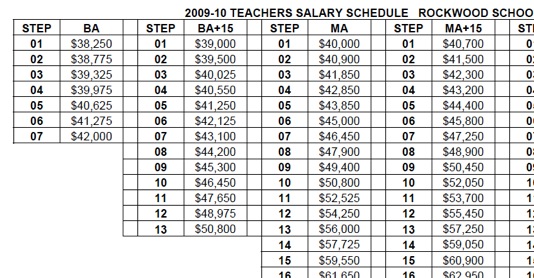
Christian Science Monitor has an article out on changing the structure of teacher pay (hat tip Abner Oakes tweet), which discusses giving bonuses for various incentives such as improving student performance or working at a high-poverty school. I have some more ideas.
First, as long as districts follow a salary schedule, teachers should get one-for-one credit for teaching in other districts; i.e., they should be given credit for teaching five years if they have taught five years when being hired at a different school district. Not giving one-for-one credit unfairly eliminates them from changing districts—they get “locked in” to a particular district after teaching for only a few years since they would have to take a pay cut to move to a different district. This elimination of competition between districts is bad for teachers. Only the wealthiest districts currently can lure experienced teachers by giving one-for-one credit since most districts do not. Let’s even that playing field.
Second, tenure needs to be much, much, MUCH! harder to get. It should not be automatic but should be something to work toward like at the college level. Professors apply for tenure going through an arduous process. I recommend the same for K-12 teachers.
Third, first year teachers should have a reduced teaching load to go with their lower salary. (I’ll expand on this idea in a post later this week.) As they gain experience and ability, they should gain responsibility, recognition and salary.
Fourth, non-performing teachers should be fired.
A more flexible salary schedule with teachers applying to move to different teacher levels equivalent to college’s instructor, assistant professor, associate professor and full professor would be a hybrid system between a strict schedule and open negotiation.
What do teachers make anyway?
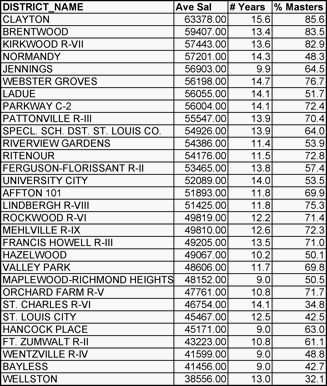
Source: DESE
I assumed that Clayton would be the top-paying district in the county, and I was correct. The average is high because the district prioritizes experience and advanced eduction. The average number of years teaching is 15.6; while Webster Groves, the next highest, is 14.7—almost a year less.
Clayton, Brentwood and Kirkwood all have over 80 percent of teachers with at least a master's degree. They are also the highest paying districts. This is no coincidence as I found a .76 correlation between average salary and percent with a master's. This is much higher than the still statistically significant .40 correlation between average salary and average number of years teaching.
At a future date I will compare the percent with a master's to quality of schools because in looking at it, that seems to be a pretty good indicator, with Ladue as a weird outlier. (What's up with Ladue only having 50 percent of its teachers with a master's? They're not young (14.1). This deserves further research.)
Length of contract affects salary
When I first read Education Gadfly's post critiquing the Quality Counts 2008 report, I was struck by his reference to teachers only working 9 months as I always had to work longer. In looking over Missouri's data, however, I can see the disconnect.
While Mo. teachers ave. 181.49 contract days, St. Louis teachers average 190 contract days with several districts at 195 or above (Mehlville, Brentwood, Lindbergh). In looking through the state numbers, some districts only required 175 or even 174 (!) days. That's as much as a four week difference. Yes, the urban districts pay more, but they also expect more of their teachers. Since Missouri's minimum number of school days is 174, some of the rural districts must not have any or minimal professional development days. I think this needs to be addressed in any minimum salary legislation.
Numbers taken from MSTA Mo. Salary Schedule and Benefits Report
Rhyme or reason to salary schedules?

The St. Louis Post-Dispatch provided an interesting graphic to accompany its Rod Jetton story which gave the district paying the most to beginning teachers and the district paying the least. I had assumed that Clayton would be the highest paying school, but I was wrong. Jennings. The lowest-paying district is Hancock Place. I wasn't surprised there. I ranked all of the districts and could discern no obvious pattern.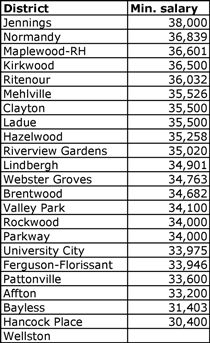
I wondered if Jennings was one of those districts that encourages beginning teachers by paying them well but doesn't reward its more experienced and educated teachers, so I also looked at maximum teacher salaries. Nope, Jennings is just a high-paying district.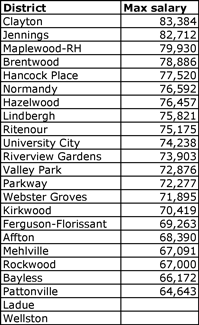
I wondered if the maximum salary was tied to the median income level of the district. Seemed reasonable that the districts in wealthier areas would pay more. With a correlation number of -.26 though, that's not the case. Other market factors are in play.
The spread between minimum and maximum salaries is important as teachers want to know that their salaries will increase. Quality Counts suggests a ratio of at least 2.0 The St. Louis districts do that to stay competitive even if the rest of the state does not (state average 1.66).
❝In fact, the salaries and career potential for teachers are remarkably flat: The average maximum salary that a teacher can earn is just 1.85 times the salary of a raw entrant, according to the National Center for Education Statistics, based on figures from the 2003-04 school year.❞
To get a better grip on which districts tighten their salary schedules, I ranked them and included whether each district has been named a district of distinction by Missouri based on MAP data.
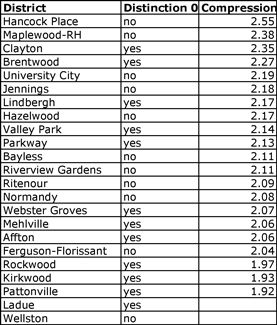
With Rockwood, Kirkwood and Pattonville the only districts under the 2.0 and on the bottom of the heap, I have to say that the compression ratio isn't the end all although I do think it's important. Studying all the districts of the state might show more of a difference rather than within a region or market area.
I ran some correlation numbers to try to figure out whether the compression ratio is more highly correlated to the maximum salary or the minimum.
Max. salary correlation .73
Min. salary correlation .24
Obviously it is tied to the max salary. Hancock Place did have the highest ratio with a low starting salary and high maximum salary. I was glad to see that the bad press it has received for its low starting salary isn't justified. Most of the time, however, low starting salaries meant little in terms of the ratio.
Summary
I doubt few prospective teachers compare salary schedules too closely as long as a district is within the regional norm, but I found it fascinating. Some of my assumptions were challenged, which will encourage me to dig deeper in the future.
Numbers from MSTA's salary schedule report
49th in teacher pay? Embarassing!
On the same week as the Quality Counts Report Card release, Mo. House Speaker Rod Jetton (R) introduced a plan to increase the state minimum for teacher's pay to $31,000, which is significantly higher than the current minimum of $23,000. The plan also includes other floors up to $46,000 minimum for the most experienced teachers. In fact he opened the 2008 session with increasing teacher pay as his first priority.
This raise would not affect the St. Louis area much as all but one St. Louis county district already exceeds the minimum (Hancock Place). St. Charles County also already meets the minimum, but some districts in Jefferson County would need to raise their salary schedules.
One of Jetton's problems is convincing the urban areas to go along with the legislation. Missouri has an urban/rural divide already, and some have the perception that the urban areas are going to pay for a benefit for the rural areas, again. Jetton counters that we need to entice young people to go into the profession in the first place and that improving rural education would also improve the county schools. (He called it the trickle up effect on the Paul Harris show on KMOX.) More practically, he said he was open to working with others to modify the bill.
The most interesting caller to me on Paul Harris's show (episode download) was the school board member who ranted about how big teachers' pensions were. I wouldn't want him on my school board--not necessarily because of his opinions but because of his lack of judgement in calling in to the show presumably against increasing teachers' pay. But maybe that's how he was elected. Jetton countered that his focus was on bringing young people into the profession.
Whatever your arguments are about whether to include benefits and the ten-month term in comparing salaries, 49th in teacher pay is embarrassing.
The unscientific but interesting Post online poll asked "What do you think of teacher salaries?"
73% They should be higher
6 They should be lower
21 They're fine where they are
(600 votes as of 1-11-08 at 8:54 a.m.)
The numbers really didn't change much as I had checked the poll Thurs. (78, 5, 17 with 348 votes)
Public opinion may be for increasing teachers' pay, at least until they see the bill, but we'll have to watch this one.